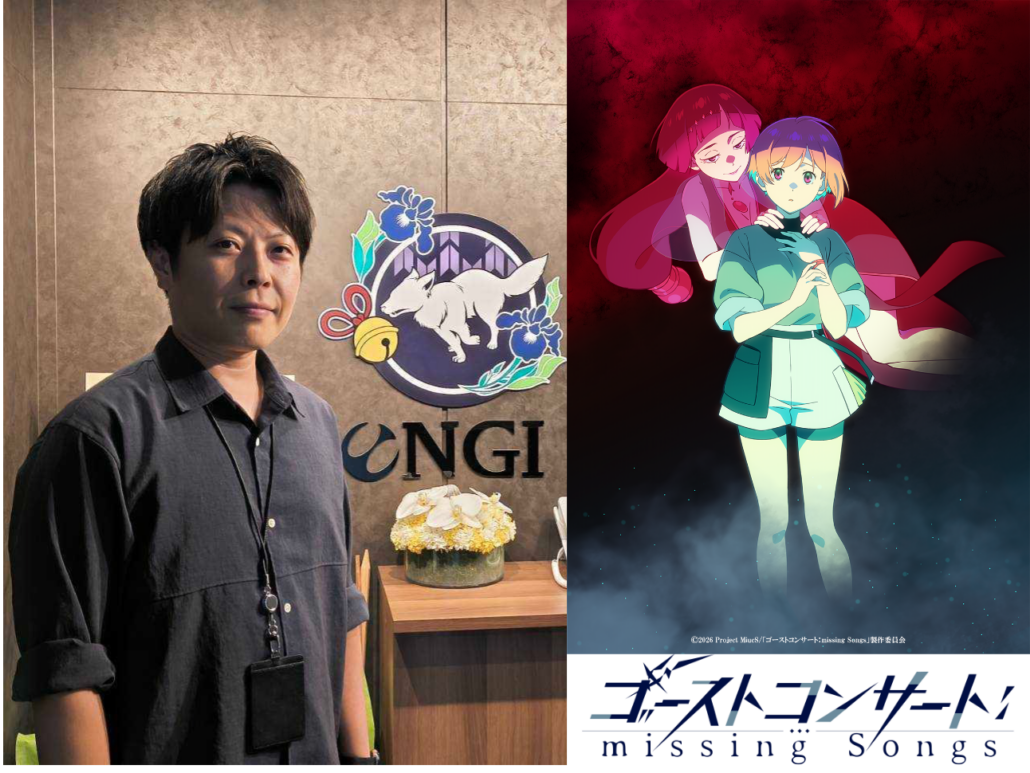
During my trip to Japan, I had the chance to see a real anime studio first-hand as well as interview anime producer Yutarou Hoshino. Here’s what he has to say about anime production and if he prefers producing original anime!

Thank you for the opportunity to be here. It’s truly a privilege to be able to visit an anime studio in person. Please introduce yourself to us. What is your current role at ENGI, and how are you involved in Ghost Concert: Missing Songs?
My name is Yutaro Hoshino, and ENGI is the first anime studio I’ve worked at. I’ve been with the studio since its founding and have been involved in the production of Ghost Concert: Missing Songs.
How did you end up at ENGI? How does the application process work? It seems you’ve already held various producer roles. Could you describe the differences between them and what each role entails?
I wanted to work at ENGI because I heard that production was going to be completely digital. Originally, anime was drawn on paper, but today and in the future, it’s impossible to do without computers. ENGI planned to have a CG department from the very beginning.That appealed to me, and I thought I would definitely be able to work on interesting projects here.
I started out as a production assistant, at the very bottom of the hierarchy. I hired animators, worked on editing… Now, as a producer, I also handle filling other team roles and try to find the right people so that the final work meets the director’s vision. I also look at how much quality we can achieve, and things like that. And of course, managing the budget is important too. I take care of that as well.
All right. From what I know, you’re currently working as a producer on more than one project. Can you tell me a bit about how that works from an organizer’s point of view? How challenging is it to oversee two production lines at the same time?
I’m currently working on Ghost Concert and Odekake Kozame. These two anime have, how should I put it, completely different styles and content. The characters also look very different—small, cute figures in one, realistic ones in the other. So it wasn’t easy to find the artists who could capture exactly the right style for each.
I totally get that. Are there any other things you have to keep in mind when working on two productions at the same time – like tight deadlines or anything like that?
In terms of visuals, we wanted to make *Ghost Concert* look especially realistic, so we used a lot of CG. Backgrounds, effects—we used a lot of CG there. *Odekake Kozame*, on the other hand, takes place in a fairy-tale world. The outlines were drawn by hand, and we used completely different techniques in other areas as well. That was quite a challenge.
Regarding scheduling and deadlines, what I can say is this: When you use a lot of CG, it means the work has to go through many different studio departments, which can make it difficult to get everything finished on time.
You also worked on In Another World With My Smartphone, but only from season 2 onward. Was there some kind of handover from the production manager of the first season? How would you describe a staff change like that?
There wasn’t really a handover. I just received the material from the first season, watched everything, and studied it thoroughly. That helped me understand how the first season had been produced, and I thought about how I should approach it.
Did you receive the data in digital or analog format?
I received all the data in digital format.
Another question about In Another World With My Smartphone: This anime was a co-production with J.C.STAFF. Can you describe the workflow in a case like this, including how both studios, which are quite far apart, communicated with each other?
We divided the tasks among ourselves. For example, J.C.STAFF wrote the script, and based on that, we created the settings and storyboards, and then the animation was done. Back then, not everything was digitized yet; we also used paper. Because of that, it sometimes happened that someone had to drive over and bring material, despite the long distance. Sometimes one of us drove over, and sometimes someone from J.C.STAFF came. Being mobile was the norm.
I’ve seen something like that in the anime SHIROBAKO! Pretty cool that that’s actually true. You mentioned the budget earlier. In the West, people have different takes on and sometimes even wrong ideas about how the size of the budget affects production quality. Could you share your thoughts on that? Do you agree that a series with a higher budget automatically has better quality? What role does money play in the production of an anime?
Yes, I agree that a high budget also improves the quality of the work. Of course, it also depends on the content, but with a higher budget, we can hire good, talented people like video editors, background artists, and so on. That applies to staff in all departments. With more money available, it’s also easier to approach well-known people in the industry. Simply put, a higher budget does mean better quality. And it gives us more time. There’s no need to rush the production, so we can devote ourselves to the work at our own pace. That’s another advantage.
ENGI is a subsidiary of Kadokawa. How much does working with or under Kadokawa affect production? Can you tell us a bit about that?
With so many different titles at Kadokawa, we have a wide range of works to choose from for production. Another advantage is that Kadokawa has many people who are knowledgeable about anime and are constantly producing anime. We can get tips and assistance from them. There is a dedicated anime team at Kodokawa that we can work with. Being able to work together as a team like this sets us apart from other studios.
How does that work? Until now, I assumed that Kadokawa would submit a request to you, and then the series would be produced. However, it sounds as if you can choose projects from a catalog, selecting what you’d like to work on or which titles sound interesting to you. Could you explain exactly how that works?
It depends. Sometimes Kadokawa wants us to produce a very specific series, and we do that. Or they give us a list of titles and ask us which ones we’d like to work on. Then again, ENGI might ask to produce a specific work, and we’ll discuss with Kadokawa whether that’s possible.
Ghost Concert is a mixed-media/original project. Compared to a novel or manga adaptation, what are the differences and what do you have to keep in mind?
Yes, it’s an original production based on songs. The biggest challenge was deciding exactly what kind of anime and what kind of story it should be. For Ghost Concert, the director wrote the script, and then my team and I worked together to try to bring to life the images the director likely had in mind. That’s where the difficulty of an original work became apparent.
Additionally, given that the project includes songs, we had to figure out how to integrate them into the anime. Those songs also had to be connected to the story. That was a challenge for me every time.
If you were to make another original title, would you want to have complete control over the production? Or would you prefer classic adaptations based on light novels or manga?
Well, producing an original work is certainly very difficult. But at the same time, it’s also very interesting, so I’d do it again anytime. On the other hand, I also enjoy producing anime based on source material like novels and manga. It’s a bit different, but I have fun figuring out how to adapt certain elements into anime. So I’d definitely like to do that again as well.
Is there anyone you look up to, whether they’re a producer or not? Are there people you look up to?
I can’t think of any specific producers off the top of my head… but I could name directors or other creative people I admire. Actually, there is someone who comes to mind who has also worked as a producer at times: Mamoru Oshii. He’s part of a team of anime and manga artists called Headgear, which I’ve been a huge fan of for a long time. I think Mamoru Oshii was the reason I got into the anime industry in the first place.
That brings us almost to our final question: How busy does ENGI expect to be with upcoming projects? In the West, there’s a lot of talk about anime studios being fully booked for long periods or even struggling to keep up due to staff shortage. Can you tell us what the future looks like in the next year or two?
We already have our production schedule set through 2028, even 2029. And as far as staffing goes, yes, I think we’ll just barely have enough people. It would be easy if we only had to decide who would work on a specific title. Unfortunately, that likely won’t be enough. That’s why I definitely want to bring more people on board.
Are you open to hiring freelancers from overseas? Can you tell us about ENGI’s approach in this regard? You often hear about Japanese studios hiring foreign animators. Have you ever considered doing that? Or is ENGI already working with animators from other countries?
We have outsourced work overseas before, but in the past it was mainly within Asia – China, Korea, and so on. Now that digitalization has advanced even further, we can also collaborate with people from America and Europe. In some cases, we even reach out to freelancers ourselves. Currently, we have a few such freelancers working with us from abroad on Ghost Concert and Medalist. I believe this trend will continue in the future.
It’s interesting for me to see this kind of thing, including the stories behind it. And, of course, the excitement when someone from Europe is involved in a Japanese anime.
That’s sure to happen more often.
Thank you very much for your time. I also have a small gift from Munich for you: chocolate from Dallmayr.
Thank you very much!
Translation and interpretation: Ekaterina Mikulich
Interview led by Steven Rettka